


Biomimicry: How the Damselfly Wing Is Revolutionizing Engineering
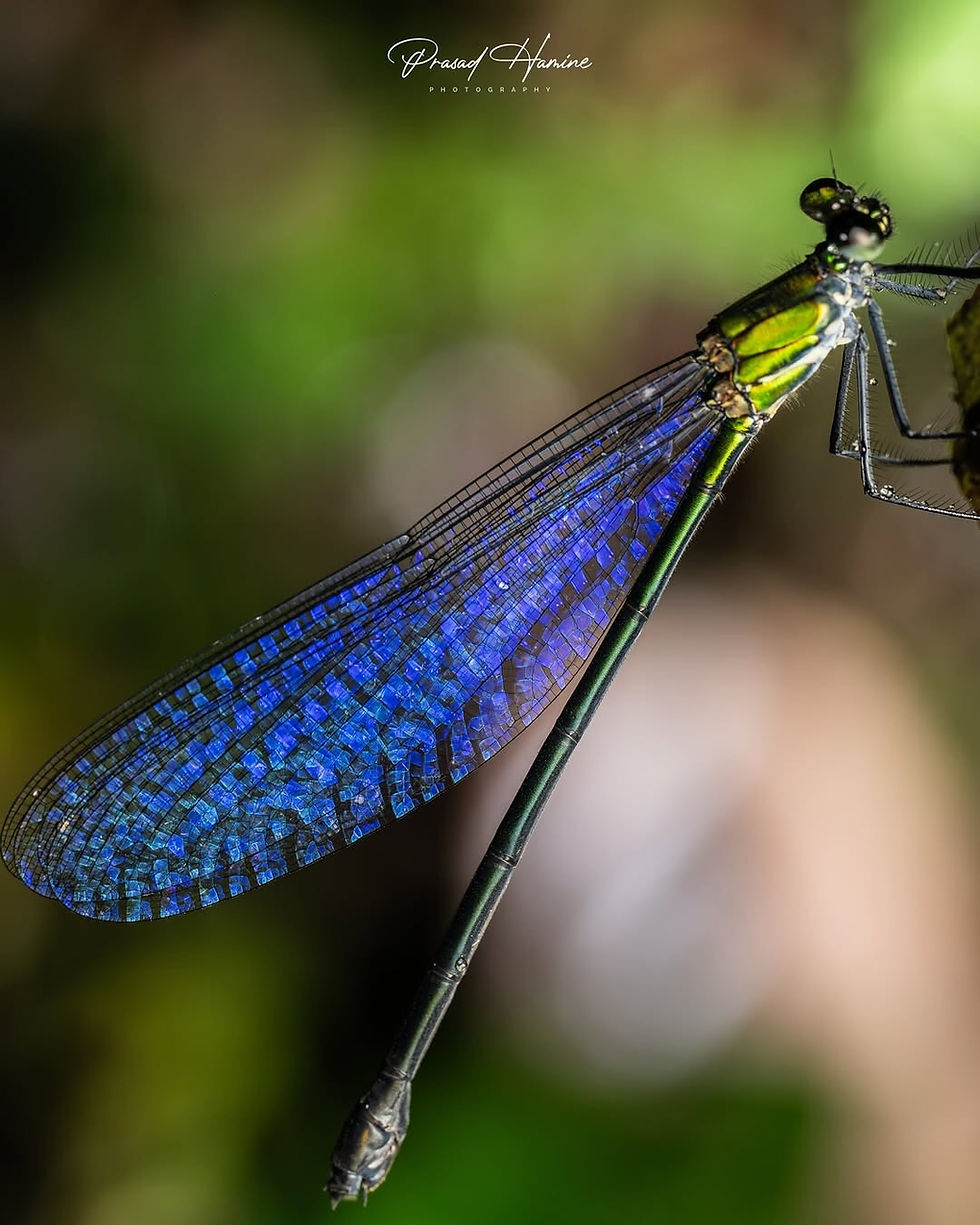
Often confused with the dragonfly, the damselfly (Calopteryx sp.) possesses one of the most sophisticated mechanical structures in the animal kingdom. Up close, its wing reveals a complex pattern reminiscent of stained glass. Yet this feature is not merely aesthetic: it represents a technological feat of formidable efficiency for biomimicry research.
A Reticulated Architecture with Aerodynamic Properties
The blue and purple hue of the wing does not stem from any pigment. It is a structural color generated by its geometry. The wing is composed of a network of chitin veins, the rigid polymer constituting insect exoskeletons, forming a reticulated venation. This mesh divides the membrane into a multitude of polygonal cells featuring a slight three-dimensional curvature.
This architectural layout serves three major functions:
Structural support: it preserves the overall geometry of the wing against deformation during flight.
Aerodynamic optimization: it generates surface micro-undulations that increase lift.
Light diffraction: each cell reflects light at a specific angle, producing this blue visual effect without an additional pigment load.
Mechanical Resistance and Self-Repair
Despite a thickness of less than 3 micrometers, 25 times thinner than a standard sheet of paper, the wing withstands flight speeds reaching 56 km/h as well as extreme acrobatic maneuvers.
This resistance relies on two physical mechanisms:
Flexible joints: the connections between the veins integrate elastic proteins capable of absorbing mechanical stresses and impacts without breaking.
Internal hydraulic pressure: the circulation of hemolymph within the venous network allows the structure to restabilize and redeploy after deformation.
Nanostructures: Self-Cleaning and Mechanical Antibacterial Action
At the nanoscale, the surface of the membrane is covered with nanopillars approximately 1,000 times thinner than a human hair. This nanotopography confers two critical functional properties upon the wing.
On the one hand, it induces superhydrophobicity that promotes self-cleaning: water droplets slide across the surface, carrying away impurities. On the other hand, it exerts a mechanical bactericidal action. The distribution and rigidity of the nanopillars physically pierce the membrane of bacteria that land on them, causing their destruction without relying on any chemical substance.
Industrial and Biomimetic Applications
The physical principles observed in Calopteryx sp. open concrete prospects for technology transfer to industry:
Civil engineering and architecture: the pattern of the reticulated venation serves as a model for designing building envelope structures and bioclimatic facades with optimal resistance to wind loads.
Aeronautics and algorithms: the wing topology has been used to train machine learning algorithms capable of generating optimized wing structures for drones or micro-air vehicles.
Medical sector: reproducing the nanopillar surface on titanium implants reduces bacterial load by 50% upon contact, offering a promising alternative for limiting antibiotic use in hospital settings.
(Credits : Prasad Hamine)

Comments